Monday, 6 January 2014
Thoughts On My Final Collection.
So now I've put together my final collection I find myself asking how do I feel about this course and what I've achieved throughout. On the whole it proved to me that still you can always find new things about photography to learn even when you think you've absorbed all you can on the subject, or there's always another way you can approach a subject to give it a slightly more original take. This I found to my pleasure with this course, I started off by going at it in a very straight kind of way, by this I mean taking the subject matter researching it then heading out with the camera to capture scenes that were associated with said subject. A good way of working I thought but as highlighted by my tutor in dew course not overly original or that engaging to people as there bombarded with these kind of images all the time. This meant a reassessment of my work and the way I was approaching the subject matter. My one worry during this process was I didn't want to end up producing photos that I didn't feel where true to life, by this I mean with Photoshop these days its so very easy to start manipulating an image until you've turned it into something that in no way represents what you original capture through the camera lens. Control is what was need and a clear idea of what each photo needed to represent. Happily I feel I achieved this creating some strong images that work better as a group then as single images on there own, I'm repeating here a lot of what I've already said during the course but now I feel much happier with how everything feels and looks as I reach the end of what has been a long photographic journey for me, now its just down to the final look over from my tutor and to come up with a good way to present my final collection.

Sunday, 5 January 2014
Garden Conservation- The Final Collection.
The final section is really a this is what you can do to help kind of piece showing people there's lots you can do in your own back garden that'll help wildlife that otherwise might struggle. There's always some way that we can be involved in conservation, if its only putting some seed out to feed a few birds it all adds up in the effort to stop a declining trend in bird numbers that is begin to take hold.


Flowering plants are vital to our insect populations that have struggled over the last few years mainly because of our wet summers. On a happy note because of last years warm settled spell in the summer insect numbers did have a sizable increase, this in part has to be the availability of food which also played in part.

Providing homes for our wildlife is just as important as offering food, main place's where wildlife would normally make its home are slowly disappearing down to our changing living habitats/house designs etc.

To finish a cautionary note, its good to encourage wildlife into your garden but you have to be aware of the issues that will arise when the local predators become wise to the fact that there's a new place where they can look for easy chances to get at there prey.

A garden doesn't have to be a concrete jungle, a few plants can soon make a difference.

Seed for our birds.

Ponds can bring all kinds of variety to your garden.

Flowering plants are vital to our insect populations that have struggled over the last few years mainly because of our wet summers. On a happy note because of last years warm settled spell in the summer insect numbers did have a sizable increase, this in part has to be the availability of food which also played in part.

Providing homes for our wildlife is just as important as offering food, main place's where wildlife would normally make its home are slowly disappearing down to our changing living habitats/house designs etc.

To finish a cautionary note, its good to encourage wildlife into your garden but you have to be aware of the issues that will arise when the local predators become wise to the fact that there's a new place where they can look for easy chances to get at there prey.
National Park Conservation- The Final Selection.
In this collection the focus is more on changing peoples attitude towards our National Parks, getting people out of there homes and into the beautiful landscapes that the country offers.

This shot I did consider re-working with the door open so the direction pointer looked as if it was encouraging you out the door, the end result just didn't look as good if I'm honest and in considering the original here you're still being directed to the door so the effect is still present.

Love the effect this photo produces really draws you into the effect, some people might not like it because you almost get the feeling of falling but it just has something about it that makes it a standout.

Wanted to use this one to illustrate the fact that it isn't just the natural beauty that our parks protect but also our history.


This version is a slight re-work on the original found under the national park section, alteration being just some slightly better eraser work here and there and uncovering the door in the corner which I left hidden in my first attempt.

Just love the juxtaposition this collection creates with the everyday scenes we see mixed in with the beauty of the natural world, its not exactly the same process I used with creating the other double exposures in this course in which I literally over layed the two images, here I was a bit more selective about what I wanted to show but the end result still creates the same kind of dynamic when you look at them of that you need a second look to really take in what you seeing.

This shot I did consider re-working with the door open so the direction pointer looked as if it was encouraging you out the door, the end result just didn't look as good if I'm honest and in considering the original here you're still being directed to the door so the effect is still present.

Love the effect this photo produces really draws you into the effect, some people might not like it because you almost get the feeling of falling but it just has something about it that makes it a standout.

Wanted to use this one to illustrate the fact that it isn't just the natural beauty that our parks protect but also our history.


This version is a slight re-work on the original found under the national park section, alteration being just some slightly better eraser work here and there and uncovering the door in the corner which I left hidden in my first attempt.

Just love the juxtaposition this collection creates with the everyday scenes we see mixed in with the beauty of the natural world, its not exactly the same process I used with creating the other double exposures in this course in which I literally over layed the two images, here I was a bit more selective about what I wanted to show but the end result still creates the same kind of dynamic when you look at them of that you need a second look to really take in what you seeing.
Woodland Conservation- The Final Selection.
Below are the photo's that best capture the issues involved within Woodland Conservation, again as with Wetlands section much of this revolves around the issues that arise from our actions within the landscape, in this cases large areas being cleared at a time without full consideration as to the knock on effects to the local ecosystem and even to our own well being.
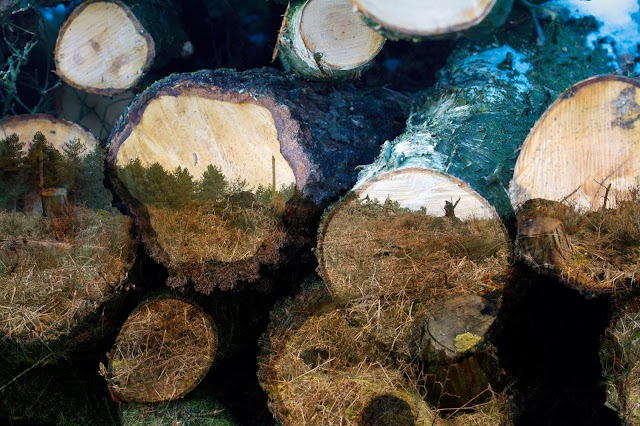

These first two photos cover the deforestation angle and how it alters the landscape in some case in completely irreparable ways, for example increased soil erosion dew to the fact the trees root systems aren't providing structure to the soil can lead to the land becoming less fertile as the wind and rain washes all the nutrients away.

This photo is more a reverse of the above problem as farmland is plant up as new woodland, is this the right approach to conserving our woodland at a time when our growing population needs to be producing more and more food?

Its all about balance, for filling the needs of nature and ourselves with out unsettling each other. Much of the time we focus far too much on our own needs without considering what effect we might be having on the wildlife that calls the woodland its home.

Here I'm illustrating the process of change on the forest floor from rotting vegetation to new life while showing the diversity to be found within the habitat.


These first two photos cover the deforestation angle and how it alters the landscape in some case in completely irreparable ways, for example increased soil erosion dew to the fact the trees root systems aren't providing structure to the soil can lead to the land becoming less fertile as the wind and rain washes all the nutrients away.

This photo is more a reverse of the above problem as farmland is plant up as new woodland, is this the right approach to conserving our woodland at a time when our growing population needs to be producing more and more food?

Its all about balance, for filling the needs of nature and ourselves with out unsettling each other. Much of the time we focus far too much on our own needs without considering what effect we might be having on the wildlife that calls the woodland its home.

Here I'm illustrating the process of change on the forest floor from rotting vegetation to new life while showing the diversity to be found within the habitat.
Wetland Conservation- The Final Selection.
Below are the photos which I have chosen which best represent the ideas behind Wetland Conservation, these are the strongest and most visually interesting and together I feel they work in away that will make people more aware of how industrial landscapes can be brought back to life. How the title of Change can be interpreted in relation to these images is that you looking at how a landscape can be changed from an industrial waste land into a heaven for wildlife and people.


Change.
After selecting my final collection of photos I come up with a title for my work which I feel better reflections the intentions and meaning behind what I'm trying to show, the new title that I'm going to use is Change. Its simple and to the point but at the same time captures the essence of what the aim of this project has been. To begin with my work started out as a simple study of conservation within these areas but as I've progressed through the course it became clearer to me with insight from my tutor and from material I've been reading that my work just couldn't be so simple, it had to be more. What I need to do was produce something that'd first show people the areas that I wanted to cover, then it needed to be strong enough so that hopefully it'd encourage people to embrace these areas/habitats that need our help thus making them hopefully change the way they see themselves and what they can do in regards to conservation within this country. Another way to look at it would be to say that my work captures the physical changes while encouraging a change in attitude that is need for conservation to truly succeed. I think this works much better then my original working title for this project as that just doesn't seem to fit as well with what I've end up producing.(The original working title was Protect or Destroy; its Our Choice, this now seems a bit too aggressive to me and as I say doesn't fit the tone of the piece.)
Thursday, 2 January 2014
Reading List.
One of the things I've kept meaning to add and is my reading list for this course, below you'll find the completed collection-
Books and Magazines.
Ansel Adams 400 Photographs.
Little, Brown & Company Nov 2007
ISBN- 978-0316117722
Landmarks
Fay Godwin
Dewi Lewis Publishing Jun 2001
ISBN- 978-1899235735
The Essential Guide To Landscape Photography
MAGBOOK 2nd Edition
ISBN- 1-907232-50-8
Digital Landscape Photography
John & Barbara Gerlach
Focus Press Sept 2009
ISBN- 978-0240810935
The Digital SLR Expert Landscapes
David & Charles Dec 2008
ISBN- 978-0715329405
2020 VISION: One Vision To Rebuild Our Natural Home.
Automobile Association Aug 2012
ISBN- 978-0749573591
The Great British Year- Wildlife Through The Seasons.
Stephen Moss
Quercus Oct 2013
ISBN- 978-17808877105
Basic Creative Photography 02: Context and Narrative.
Maria Short
AVA Publishing July 2011
ISBN- 978-2940411405
Websites.
www.anseladams.com- Ansel Adams
www.woodlandtrust.org.uk- Woodland Trust.
www.forestry.gov.uk- Forestry Commission.
www.wwt.org.uk- Wildfowl and Wetland Trust.
Books and Magazines.
Ansel Adams 400 Photographs.
Little, Brown & Company Nov 2007
ISBN- 978-0316117722
Landmarks
Fay Godwin
Dewi Lewis Publishing Jun 2001
ISBN- 978-1899235735
The Essential Guide To Landscape Photography
MAGBOOK 2nd Edition
ISBN- 1-907232-50-8
Digital Landscape Photography
John & Barbara Gerlach
Focus Press Sept 2009
ISBN- 978-0240810935
The Digital SLR Expert Landscapes
David & Charles Dec 2008
ISBN- 978-0715329405
2020 VISION: One Vision To Rebuild Our Natural Home.
Automobile Association Aug 2012
ISBN- 978-0749573591
The Great British Year- Wildlife Through The Seasons.
Stephen Moss
Quercus Oct 2013
ISBN- 978-17808877105
Basic Creative Photography 02: Context and Narrative.
Maria Short
AVA Publishing July 2011
ISBN- 978-2940411405
Websites.
www.anseladams.com- Ansel Adams
www.woodlandtrust.org.uk- Woodland Trust.
www.forestry.gov.uk- Forestry Commission.
www.wwt.org.uk- Wildfowl and Wetland Trust.
www.faygodwin.com- Fay Godwin
homes.rspb.org.uk- RSPB Give Nature A Home.
www.2020v.org- 2020 VISION
www.andyrouse.co.uk- Andy Rouse.
www.scottishnaturephotography.com- Fergus Gill.
www.joecornishgallery.co.uk- Joe Cornish.
www.paulharrisphotography.com- Paul Harris.
www.terrywhittaker.com- Terry Whittaker.
www.nationalgeographic.com- National Geographic
homes.rspb.org.uk- RSPB Give Nature A Home.
www.2020v.org- 2020 VISION
www.andyrouse.co.uk- Andy Rouse.
www.scottishnaturephotography.com- Fergus Gill.
www.joecornishgallery.co.uk- Joe Cornish.
www.paulharrisphotography.com- Paul Harris.
www.terrywhittaker.com- Terry Whittaker.
www.nationalgeographic.com- National Geographic
Subscribe to:
Posts (Atom)